
February 16, 2026
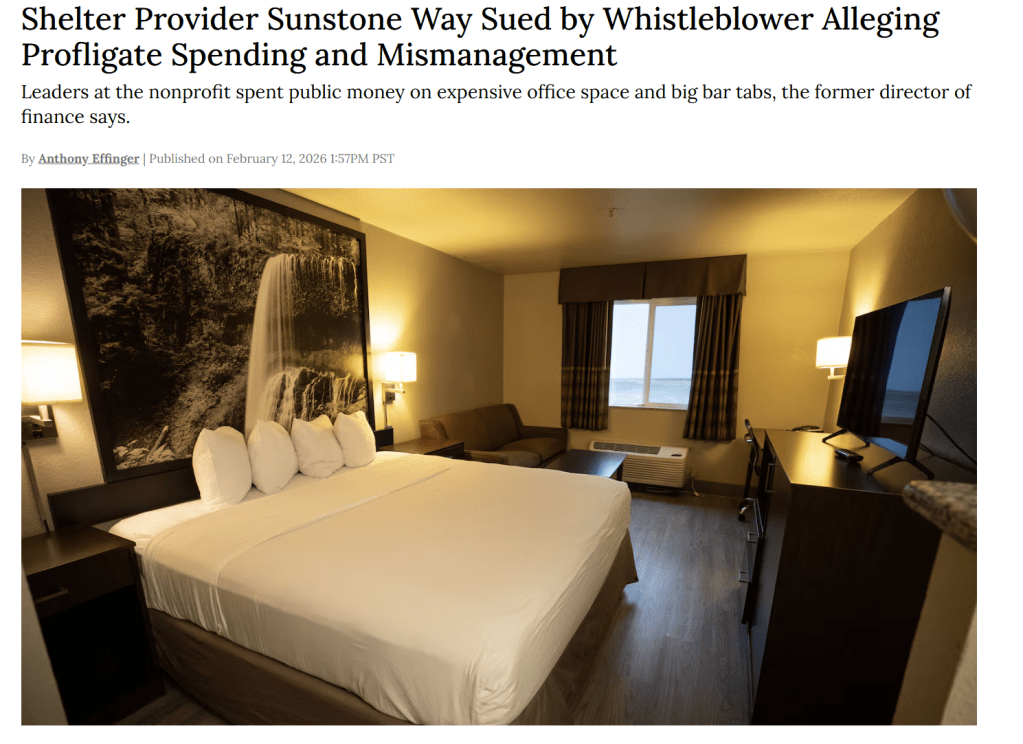
This story is deeply disturbing. A shelter provider is being accused of profligate spending and mismanagement, and the issue only came to light because someone on the inside had the courage to speak up.
While this specific situation must be investigated, once again it is not an isolated incident that happened to be discovered at Multnomah County.
As with the rampant turnover of core County department leadership, this reflects a broader pattern: lack of oversight and accountability, with spending utterly disconnected from verified outcomes.
Last April, the County’s Homeless Services Department briefed the County board on shelter types and costs. The presentation misinterpreted its own data and drew sweeping conclusions – namely, that certain types of County shelters cost more than others, and that some types of shelter worked better than others.
The conclusions were patently unsupported.
Here is what the County’s own data actually showed about congregate shelters for its most vulnerable residents:
- Only 14.8% were placed into housing
- The County could not reliably trace what happened to the others, except to say that 76.6% either returned to homelessness or were unaccounted for
Far from supporting claims about effectiveness of one type of shelter vs. another, the County’s figures pointed to a non-system in complete disarray operating without basic performance controls.
Unfortunately, the County’s inaccuracies were accepted at face value by commissioners, then parroted in the media, creating a grossly misleading public narrative echoing the County’s own deceptive talking points.
As a commissioner, I regularly asked for a presentation on shelter types, costs, and outcomes, but the information was never provided. It is not surprising that, when the information was finally presented, it was with a new board that lacked background and understanding to ask the difficult questions.
Almost a year later, those questions still have not been asked, yet alone answered, and we continue to rely on whistleblowers to reveal County mismanagement.
Last year I created a spreadsheet of shelter operations and costs because the County had not done so. It revealed striking inconsistencies – wildly different costs for similar services, unexplained variations in provider budgets, no correlation between shelter type and cost, and no clear link between spending and outcomes.
As seen in the spreadsheet, in FY 2025, Sunstone Way operated the Naito Parkway Safe Rest Village at approximately $100,000 per bed per year. It charged roughly $55,000 per bed per year at its congregate Market Street Shelter (essentially cots in a warehouse).
Those numbers alone should have triggered serious oversight questions.
They did not.
We must not let this story become about money. It is about people. Every dollar mismanaged is a dollar not helping someone transition safely into housing. Every contract or management failure is a missed opportunity to stabilize a life.
And the underlying problem is structural. Multnomah County does not operate with:
- Standardized payment models
- Contracts with nonprofits based on payment for results
- Transparent performance reporting
- A validated, real-time By-Name List to track individuals from shelter to housing
Without those tools, the County cannot answer the most basic questions:
- Who entered shelter?
- Who exited to housing?
- Who returned to homelessness?
- At what cost?
And when we cannot answer those questions, accountability disappears.
The good news: This is fixable.
But it will take more than a County board just talking about accountability; it will require action and a roadmap.
My County Homeless Services Turnaround Plan proposes:
- Results-driven contracting for shelter providers tied to verified housing outcomes
- Standardized payment rates
- Streamlined and coordinated nonprofit management
- Public performance dashboards
- A real-time By-Name List to track every individual from entry to housing stability
If we have the will to change how the County does business, there’s a way.
 Sharon Meieran: Fixing Multnomah County