
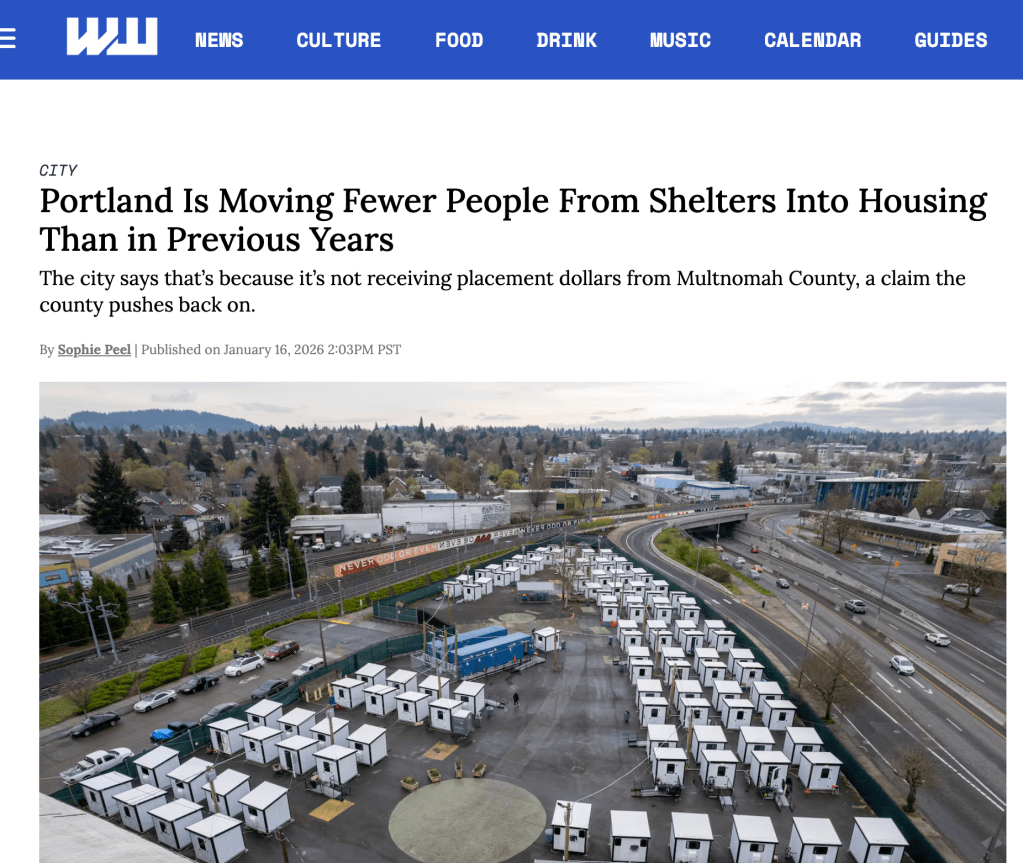
This is a confusing article, because the City reaches the right conclusion but for the wrong reasons.
The right conclusion: Multnomah County is utterly to blame for the fact that Portland moved fewer people from shelter to stable housing from 2024-2025.
The wrong reason: That it’s about spending.
The reality: The County alone has sufficient money to substantially reduce chronic homelessness. They’ve spent billions, yet homelessness has grown five-fold in the last five years.
The problem is that the County has used its wealth so ineffectively, for so long, without measuring true outcomes, without accountability, and without collaboration, that it has succeeded only in producing a system of waste, redundancy, blame shifting and most of all, failure to actually help people who need it.
The solution: Understanding what cities and counties that have effectively solved unsheltered homelessness have done right, and doing those things in Multnomah County.
The good news: It’s neither as hard, nor as expensive, as they’ve been making it.
What works: Many cities and counties have substantially reduced homelessness because they have effective end-to-end systems that successfully get people housed. They have six things in common that Multnomah County lacks:
- Independent experts planning and running their homeless-to-housing systems (not politicians);
- Services that intend to effectively transition people from shelter to housing (not largely unmonitored nonprofits that mostly do their own thing, but do not provide transition services);
- Matching the level of support to the level of people’s need once they’re housed (people with serious mental illness and/or addiction get the services they actually need and are not allowed to “opt out”);
- Confirming that the same people stay housed over time (not simply measuring “placements” then abandoning people once they’re placed, or failing to check that they stay housed);
- Measuring the end results that matter instead of process points (not “placements,” “referrals,” “people served,” “beds,” or “percentages” of populations that are undefined);
- Paying for success (to ensure they get value for money spent and pay providers who deliver).
Successful communities prove their success: Cities and counties that have substantially reduced homelessness know their approaches are working because they measure outcomes that show they’ve made a difference in what they’re actually trying to achieve:
- Reduced re-entries into shelter by people who have been placed in housing
- Reduced cycling through ERs and jails
- Improved retention of the same people in the same units of housing over time.
Where we are now: Multnomah County is responsible for mental health and addiction services, homeless outreach and transition services, and home-based support. Furthermore, it has virtually all the homeless services money.
Yet it does none of the things that have resulted in success everywhere else in the country.
County leadership knows how badly it’s doing and recently we’ve even seen them trying to pivot to say some of the right things. In this article, and in the County’s recently issued report that is short on meaningful data but long on rhetoric stating the obvious, we see the County acting like they’ve suddenly realized they should not be spending as much on shelter and spending more on preventing homelessness and getting people housed.
None of this is new. The County has succeeded in masking its failures by doing two things well – deflecting blame and claiming success based on process smoke and mirrors. The path forward requires disrupting that narrative.
The County has proven over time that it cannot partner, spend money effectively, or deliver because it is not structured or managed to do those things.
A better path forward: It’s time to stop the madness. But not by just spending more as the city wants. That would only make things worse, creating an even more fragmented, unaccountable system that does not receive value for the money it spends.
If we’ve learned anything from the abject failure of our local government to solve homelessness, it’s that spending more or changing names on the door does not magically lead to success.
The answer lies in measuring what matters, tying spending to results and holding leaders accountable.
The good news is that creating an effective system that successfully transitions people into stable housing is neither as hard nor as expensive as we’ve been making it. The plan I created, informed by local experts, and engaging the City as a true partner – with the resources to do their job, will do more for 25% less than the County is currently spending.
 Sharon Meieran: Fixing Multnomah County